Minoshi is a 20-year-old young women with Down syndrome who lives with her parents and siblings in a rural village in Sri Lanka. Although she grew up in a supportive family environment, she faced exclusion and stigma in the broader community. Minoshi began her education at a government school in her village but later had to move to a special education school because the mainstream school could not provide inclusive learning support. After leaving school, she remained at home due to the discrimination she experienced in public spaces. This isolation gradually distanced her from community life and limited her opportunities to develop skills or participate in economic activities.
Minoshi and her family began to view disability differently, not as a limitation that defines her future, but as a challenge that can be overcome with the right support and opportunities.
Minoshi’s journey toward economic participation began through the EWG project implemented by WDC and its partners. Her mother attended awareness sessions organised by the project on inclusion, women’s rights and livelihood opportunities, which encouraged her to seek support for her daughter. Through engagement with project staff, Minoshi and her family began to view disability differently, not as a limitation that defines her future, but as a challenge that can be overcome with the right support and opportunities. These sessions helped Minoshi build self-belief and recognise that she too could learn skills and earn an income.
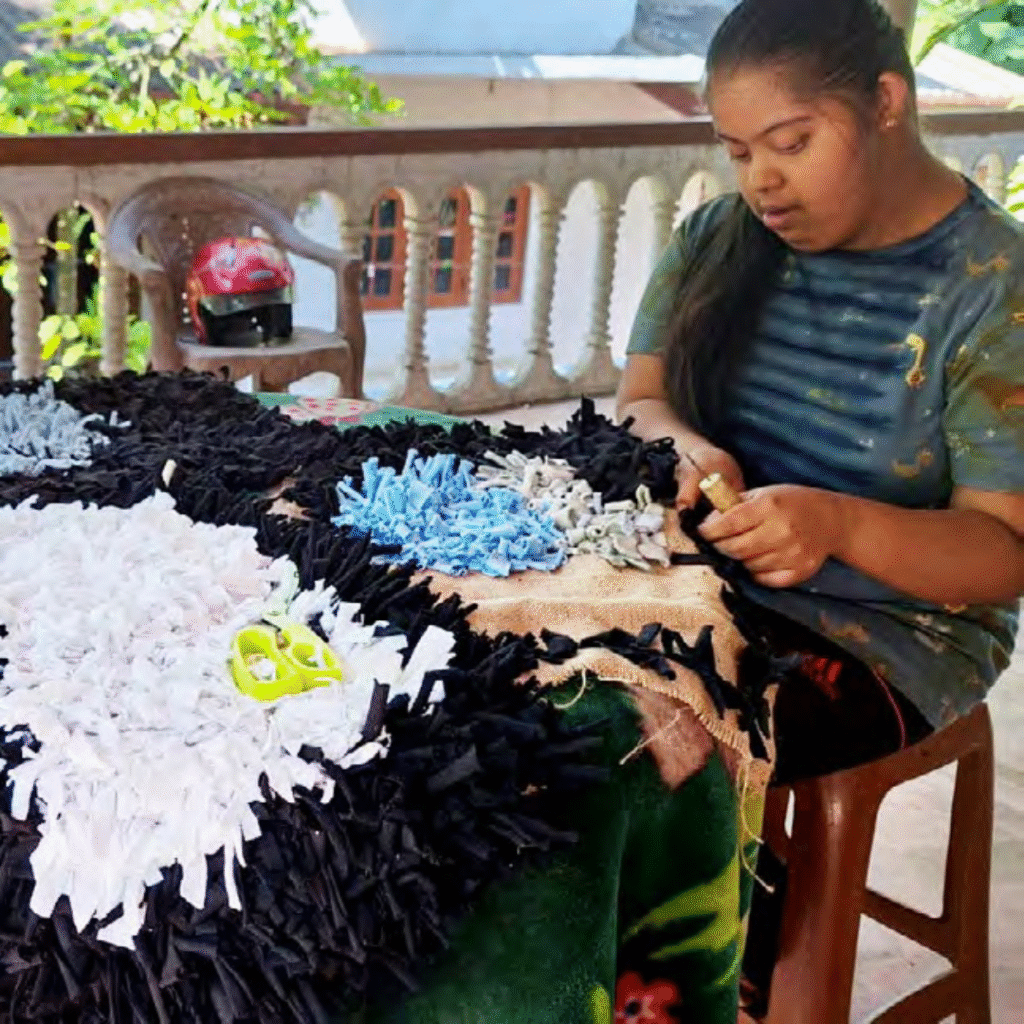
Exposure to different livelihood options enabled Minoshi to discover her interest in carpet-making, marking a significant shift in her aspirations — from seeing herself as someone dependent on care to envisioning herself as a potential income earner. The EWG project referred Minoshi and her mother to a TVET institution, where they enrolled in a one-year carpet-making course with financial support from the project.
The training provided practical skills in carpet-making alongside business development and financial literacy. Inclusive teaching approaches, such as repeat demonstrations, hands-on practice, simplified instructions and regular mentoring, allowed Minoshi to learn at her own pace while building confidence in her abilities. With this support, she successfully completed the training and in March 2025 established a small home-based carpet-making enterprise.
Initially, members of the community expressed doubts about her ability to produce quality products or sustain a business. However, Minoshi’s determination and the quality of her work gradually dispelled these prejudices. She began selling her carpets within the village, gaining acceptance and trust among local buyers. Encouraged by this progress, she now aspires to improve the design and quality of her products to reach wider markets.
In just nine months, Minoshi’s production increased from 4–6 handmade carpets per month to 10–15 carpets, generating an income of US$20.00–$25.00 per month, a significant step forward from having no personal income. She now deposits her earnings in her own bank account, marking her first experience of independent financial management and inclusion in the formal financial system.
For Minoshi, the transformation has been equally profound; she has gained confidence, dignity and a renewed sense of purpose.
Beyond the economic gains, Minoshi’s journey has created meaningful social change. Community members increasingly recognise her as a skilled and productive individual, rather than focusing on her disability. Her entrepreneurship challenges long-standing stereotypes about women with disabilities and demonstrates their potential to contribute economically and socially when given equal opportunities. For Minoshi, the transformation has been equally profound; she has gained confidence, dignity and a renewed sense of purpose. She now participates more actively in community life and remains optimistic about expanding her enterprise in the future.
Minoshi’s story illustrates the long-term impact of inclusive empowerment initiatives. Through awareness-raising, skills training, mentoring and financial support provided by the EWG project and WDC, a young woman who once faced isolation has become an entrepreneur and a role model in her community. Her journey highlights how inclusive development can break social barriers, shift perceptions and demonstrate that ability, not disability, defines potential.
“People thought I could not do anything because of my disability. After the training, I earn my own money from carpet making. Now people respect me. I feel confident and happy because I can do something on my own.”
Contributed by a female entrepreneur from a village in Sri Lanka.